

Last Updated: October 26, 2026
Quick Summary
Buy replacement axle shafts for trail rigs from a specialist seller who knows your platform's fitment, stocks real inventory, and stands behind the part. Confirm your vehicle year, model, and axle type, then verify length, spline count, and flange pattern against the listing before ordering. We stock a 30-spline CV axle set for classic Toyota pickups and 4Runners.
- Confirm axle assembly, side, and joint style before measuring any shaft.
- Stock Toyota shafts neck down from 30 splines to 27 at the CV joint.
- 4340 chromoly is the default upgrade for locked rigs on 33- to 37-inch tires.
- Warranty terms often exclude U-joint failure, so read that clause first.
- Carry one spare inner and outer shaft per driven side on the trail.
Table of Contents
- Start With Fitment: Vehicle, Axle, and Joint Style
- Axle Shaft Measurement: Length, Splines, and Flange Bolt Pattern
- Axle Shaft Spline Count: Why 27, 30, 35, and 40 Matter
- Heavy-Duty Axle Shafts: 4340 Chromoly, 300M, and 1550 U-Joints
- Where to Buy Replacement Axle Shafts for Trail Rigs
- Trail Spare Axle Parts: What to Carry and How to Store Them
- Frequently Asked Questions
Start With Fitment: Vehicle, Axle, and Joint Style
Knowing where to buy replacement axle shafts for trail rigs starts with knowing exactly what your rig needs. Fitment is the whole game. Order the wrong length or spline count and you're stuck with a paperweight, not a trail fix.
Axle shafts transfer power from the differential to the wheel hub and fail differently by axle design. Get the three basics right before you shop.
Solid Axle vs. Independent Front Suspension
Solid axle rigs run a single housing with shafts that flex with the suspension. Independent front suspension splits the axle into separate half-shafts with CV joints at each end. The parts are not interchangeable.
Solid-front-axle Tacoma, 4Runner, and Land Cruiser builds take traditional axle shafts; later IFS trucks take CV-style half-shafts. Confirm which you have before ordering.
Where Stock Shafts Fail
Stock shafts break at predictable points. On classic Toyota solid axles, the factory shaft necks down from 30 splines at the differential to 27 at the CV joint, that transition is the weak link.
Rock crawling and big tires load that neck until it snaps. Plan your upgrade around that failure point.
Axle Shaft Measurement: Length, Splines, and Flange Bolt Pattern
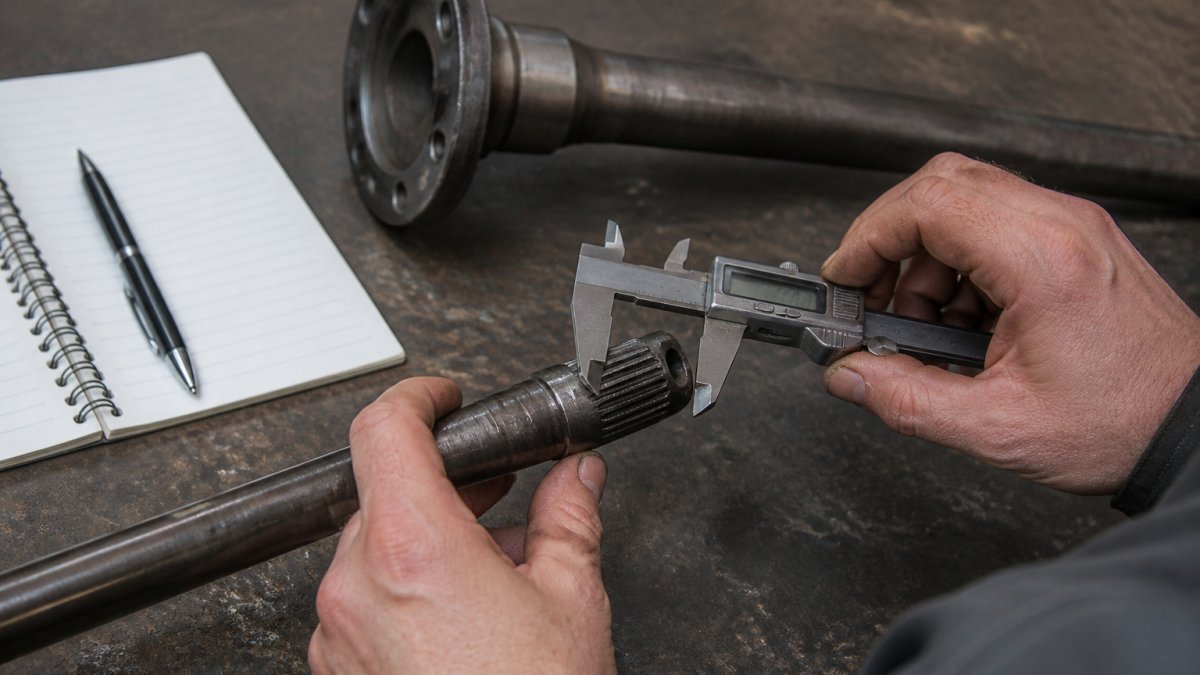
Measure your shaft before buying a replacement. Three numbers decide fitment: overall length, spline count, and flange bolt pattern. Get one wrong and it won't install.
Identify the Axle Assembly Before You Measure
Most fitment errors start before the calipers come out. Confirm the axle assembly first, the same vehicle can carry different axles across trims and model years.
Work through this identification sequence:
- Year, make, model, and trim. A mid-1980s Toyota pickup and a later 4Runner may share a platform but not a front axle; trim and engine change the axle spec.
- Axle family. Check housing shape and differential cover pattern. Common trail-rig families, Toyota 8-inch solid front axle, Dana 30, Dana 44, Dana 60, each use different shaft dimensions and spline counts.
- Axle assembly code. Domestic axles often carry a stamped or tagged code on the housing or cover; Toyota axles carry one on the firewall plate or door jamb. Photograph the tag before cleaning it off.
- Side. Left and right shafts are usually different lengths, even on the same axle. Label them before you set them down.
- Joint style. Confirm whether the shaft uses a U-joint or a CV joint, and note the joint series.
No code? Measure housing width and differential cover bolt count against a factory service manual.
How to Measure an Axle Shaft Correctly
Once you know the axle family, measure the shaft and write each number down:
- Lay the shaft flat and measure overall length from the flange face to the shaft tip.
- Count the splines at the differential end, then at the outer end if they differ.
- Measure the flange bolt pattern center-to-center across the bolt holes.
- Note the U-joint or CV series stamped or cast on the joint.
- Photograph the shaft next to a tape measure for reference.
Don't measure a compressed shaft as if extended, measure in its natural resting position.
Worked Example: A Classic Toyota Solid Front Axle
On a classic Toyota solid front axle, the factory inner shaft is described by both its differential-end and outer-joint spline counts, commonly 30 at the differential necking to 27 at the CV joint.
The flange bolt pattern and joint series must also match. A shaft with correct length and spline count but the wrong flange pattern won't bolt to the hub, which is why the photo gives you and the seller a shared reference.
What to Do When the Numbers Don't Match
If measurements fall between two listed sizes, don't round. Call the seller with the axle code, year/make/model/trim, and measured length.
Axle Shaft Spline Count: Why 27, 30, 35, and 40 Matter
Spline count is the number of teeth cut into the shaft end and sets how much torque it can carry. More splines spread load across more contact area, raising strength.
Here's how the common counts compare:
| Spline Count | Typical Use | Strength Note |
|---|---|---|
| 27 | Stock Toyota outer CV | Common failure point |
| 30 | Upgraded Toyota CV | Eliminates neck-down |
| 35 | Super Duty Dana 60 outer | Strong middle ground |
| 40 | Hardcore Super Duty builds | Highest load capacity |
For Toyota builds, moving from a 27-spline outer to a 30-spline CV removes the weak transition entirely. For Ford Super Duty Dana 60 axles, you can compare a 35-spline 1550 chromoly outer shaft against a 40-spline version of the same shaft to see how the jump in spline count changes the load rating.
RCV Performance Ultimate 30 Spline CV Axle Set — 1979-1985 Toyota Pickup →

Heavy-Duty Axle Shafts: 4340 Chromoly, 300M, and 1550 U-Joints
Heavy-duty axle shafts are forged from stronger alloys and paired with larger U-joints to tolerate shock loads that snap stock parts. Material and joint series matter more than marketing claims, but the right choice depends on tire size, gearing, engine output, and terrain.
Material Comparison: Stock, 4340 Chromoly, and 300M
Stock shafts use lower-alloy steel sized for factory power and tires. Cheapest, fine for mild trails, but the first part to fail once you add bigger tires or a locker.
4340 chromoly is the workhorse upgrade steel, forged for toughness and far better under trail abuse.
300M is a step above chromoly for the most demanding applications.
| Material | Relative Strength | Relative Cost |
|---|---|---|
| Stock | Baseline | Lowest |
| 4340 chromoly | Moderate to high upgrade | Moderate |
| 300M | Highest upgrade | Highest |
Joint Design: U-Joint vs. CV vs. Birfield
Shaft material is only half the decision, joint style controls articulation and behavior at full steering lock.
- U-joint-style shafts are simple, strong, and trail-serviceable, but bind at extreme steering angles, limiting articulation and stressing the joint at full lock.
- CV-style shafts stay smooth through a wider steering range. Common on IFS half-shafts and upgraded solid-axle setups where articulation matters.
- Birfield joints are the classic Toyota solid-axle CV joint. They articulate well but wear and fail with large tires and a locker; upgraded higher-spline birfield-style CVs fix the stock neck-down weak point.
1550 U-joints are larger than the 1480 joints on many stock axles, translating to more joint strength.
Matching the Shaft to Your Rig
Narrow the choice before you shop:
- Tire size. Larger tires multiply torque load. Stock shafts are usually adequate to about 33 inches.
- Gearing and engine output. Lower gears and more torque increase shock load; a low-geared rig with a locker stresses shafts harder than stock.
- Terrain and driving style. Rock crawling and bouncing favor stronger alloys and larger joints; overland and fire-road use is easier on parts.
For a concrete 300M example, the RCV Ultimate 30-spline CV axle set with 300M shafts shows a full material upgrade on a classic Toyota platform.

Where to Buy Replacement Axle Shafts for Trail Rigs
Buy from a seller who knows fitment, stocks real inventory, and stands behind the part.
A specialist who wheels your platform will catch errors before shipping.
What to Check Before You Order
Run this checklist every time:
- Confirm vehicle year, model, and axle type
- Verify length, spline count, and flange pattern against the listing
- Check the U-joint or CV series matches your setup
Watch out: warranty terms often exclude U-joint failure. Read that clause before you buy, not after.
We stock a 30-spline CV axle set for classic Toyota pickups and 4Runners if you're ready to order a direct-fit upgrade.

Trail Spare Axle Parts: What to Carry and How to Store Them
Carry a spare shaft for each side you're likely to break, plus the tools to swap it.
Pack these trail spare axle parts:
- One spare inner and outer shaft per driven side
- A spare U-joint or CV joint
- Spindle nuts and snap rings
Store shafts wrapped in heavy cloth or foam and strapped flat so splines don't get nicked, a damaged spline won't slide into the differential when you need it most.
Frequently Asked Questions
How much does a replacement axle shaft cost?
Pricing depends on the axle, joint style, and material. For the 2005-and-up Ford Super Duty Dana 60, Branik Motorsports 1550 chromoly outer shafts run $244.99 in a 35-spline configuration and $278.99 in a 40-spline configuration. For 1979-1985 Toyota Pickup and 1984-1985 4Runner solid axles, the RCV Performance Ultimate 30 Spline CV Axle Set is $853.99, and the version with 300M inner shafts is $1,066.99. Both RCV sets include right and left shafts and two pregreased CV joints.
How do I measure how long my axle shaft is for replacement?
Pull the shaft and measure from the flat face of the inner splined end to the flat face of the outer end, not across the U-joint or CV body. Record the axle shaft measurement to the nearest 1/16 inch, then note the spline count at both ends and the flange bolt pattern. Compare that to the seller's fitment listing. If the listing only names a vehicle, ask for the measured length before ordering, especially on custom or swapped axles.
How do I know if my axle is 28 or 31 spline?
Count the splines on the end of the shaft, or check the axle tag and the vehicle's build information. Spline count is not universal across axles, so do not assume from the vehicle model alone. For example, the 2005-and-up Ford Super Duty Dana 60 outer shafts are offered in 35- and 40-spline versions, while the 1979-1985 Toyota solid front axle uses 30 splines at the differential and necks to 27 at the CV joint. Confirm your axle shaft spline count before ordering.
Should I carry a spare axle shaft on the trail?
Yes, if you run big tires, lockers, or rock crawling, carry at least one spare shaft for the corner most likely to break and the tools to swap it. Trail spare axle parts should include the shaft, the correct U-joint or CV, spindle nuts, and seals. Store them in a sealed bag with the hardware labeled. A spare turns a broken axle into a trailside repair instead of a tow.
Fitment mistakes and weak stock shafts are the two things that end trail days early. 4XNation fabricates TOY60 axles and weld-it-yourself kits in-house, tests every part on our own rigs before it hits the catalog, and staffs the phones with people who wheel the same platforms. Get started with 4XNation and build an axle setup that holds up on the hardest trails.

0 comments